
Skagway Municipality Death Index
The Skagway Municipality death index covers vital records for one of Alaska's most historically documented small communities. Skagway's role as the gateway to the Klondike Gold Rush in 1898 created an unusually rich set of early death records, including coroner's reports and newspaper accounts from that chaotic period. Current death index searches route through the Alaska Health Analytics and Vital Records Section, which holds certified death records for all Alaska municipalities including Skagway.
Skagway Municipality Death Index
Skagway and Its Records
Skagway is a small unified municipality at the northern end of the Lynn Canal in Southeast Alaska. It sits at the foot of the White Pass and the Chilkoot Pass, both of which became famous during the Klondike Gold Rush of 1898. Tens of thousands of stampeders passed through Skagway in the late 1890s on their way to the Yukon goldfields. Many never made it. The town became a chaotic, dangerous place almost overnight, and the deaths that occurred there during this period are among the most documented early death records in Alaska.
Skagway today is a small community with a permanent population of roughly 1,000 people. It is, however, one of Alaska's busiest cruise ship ports during the summer months. Visitors far outnumber residents during the tourist season. This means local services are somewhat disproportionate to the permanent population, and the municipality maintains a professional administrative staff year-round.
The Municipality of Skagway operates out of 700 Spring Street, Skagway AK 99840, phone (907) 983-2297. The Municipal Clerk handles local recorder functions including deeds, mortgages, and liens. The Assessing Department at the same address maintains property tax assessment records. Neither office issues death certificates. Certified death records come from HAVRS.
The Municipality of Skagway's website at skagway.org provides contact information for all municipal departments. The screenshot below shows the municipality's official web presence.
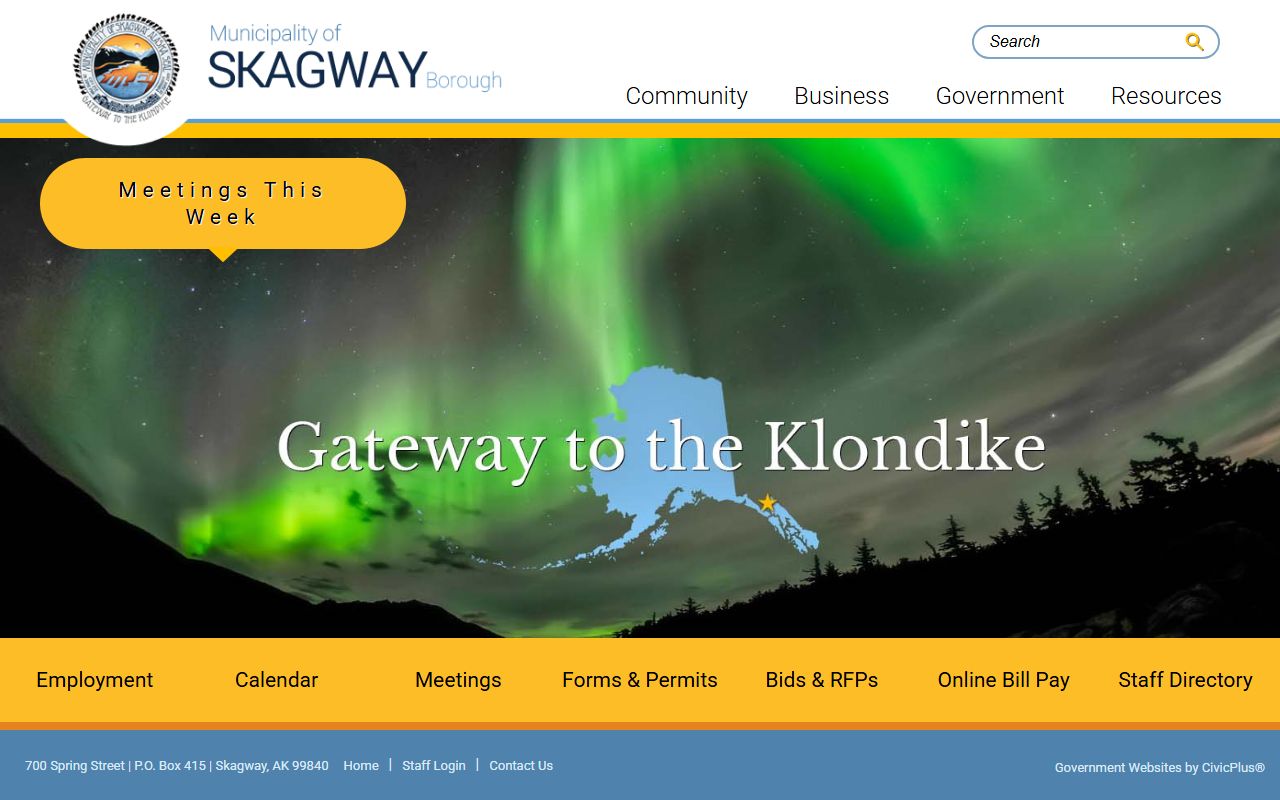
The municipality's website is the best first contact for questions about local administrative records, property matters, and referrals to state or federal agencies for vital records.
How to Get Certified Death Records
Certified death certificates for Skagway come from the Alaska Health Analytics and Vital Records Section. HAVRS is the only source for certified copies of Alaska death records. No local Skagway office can issue them.
The HAVRS main office is in Juneau at 5441 Commercial Blvd, Juneau AK 99801, phone (907) 465-3391. Skagway is about 90 miles north of Juneau by ferry or small plane, so the Juneau office is the nearest in-person option. An Anchorage office is also available at 3901 Old Seward Hwy Suite 101, Anchorage AK 99503, phone (907) 269-0991 if that is more convenient.
Mail requests go to P.O. Box 110675, Juneau AK 99811-0675. Online orders are processed through VitalChek at vitalchek.com. This is typically the fastest option for people who do not want to travel to Juneau or Anchorage. The HAVRS orders page at health.alaska.gov has current order forms, fee schedules, and instructions for all three request methods.
The fee for the first certified copy is $30. Additional copies ordered at the same time cost $25 each. Deaths that occurred 50 or more years ago are public records and can be ordered by anyone without relationship documentation. Deaths within the past 50 years require proof of relationship or a documented legal interest. Valid photo ID is required for all requests.
Gold Rush Era Death Records
Skagway's Gold Rush history gives it an unusually rich set of historical death records. During the summer and fall of 1898, Skagway was one of the most dangerous towns in North America. Shootings, accidents, disease, and the brutal physical demands of climbing the Chilkoot Trail or White Pass in all weather killed many of the stampeders who passed through. A local coroner was kept busy, and those records survive in several collections today.
The Skagway Coroner's Records from 1898 through 1935 are available through FamilySearch. This collection is searchable online at no cost and is one of the most specific historical death record collections available for any small Alaska community. If you are researching a death in Skagway during the Gold Rush period or the decades after, this is the first place to look. FamilySearch is accessible at familysearch.org.
The Skagway News and the Skagway Daily Alaskan were local newspapers that operated during the Gold Rush era. Both newspapers published death notices, obituaries, and accounts of violent deaths that were local news events. Historical issues of these newspapers are held by the Alaska State Archives and can help identify deaths that may not appear in official records. The archives' genealogy collection at archives.alaska.gov is searchable online and covers 1816 through 1998.
The Alaska State Archives genealogy collection is one of the most comprehensive resources for historical Alaska death research. The screenshot below shows the archives' genealogy portal.
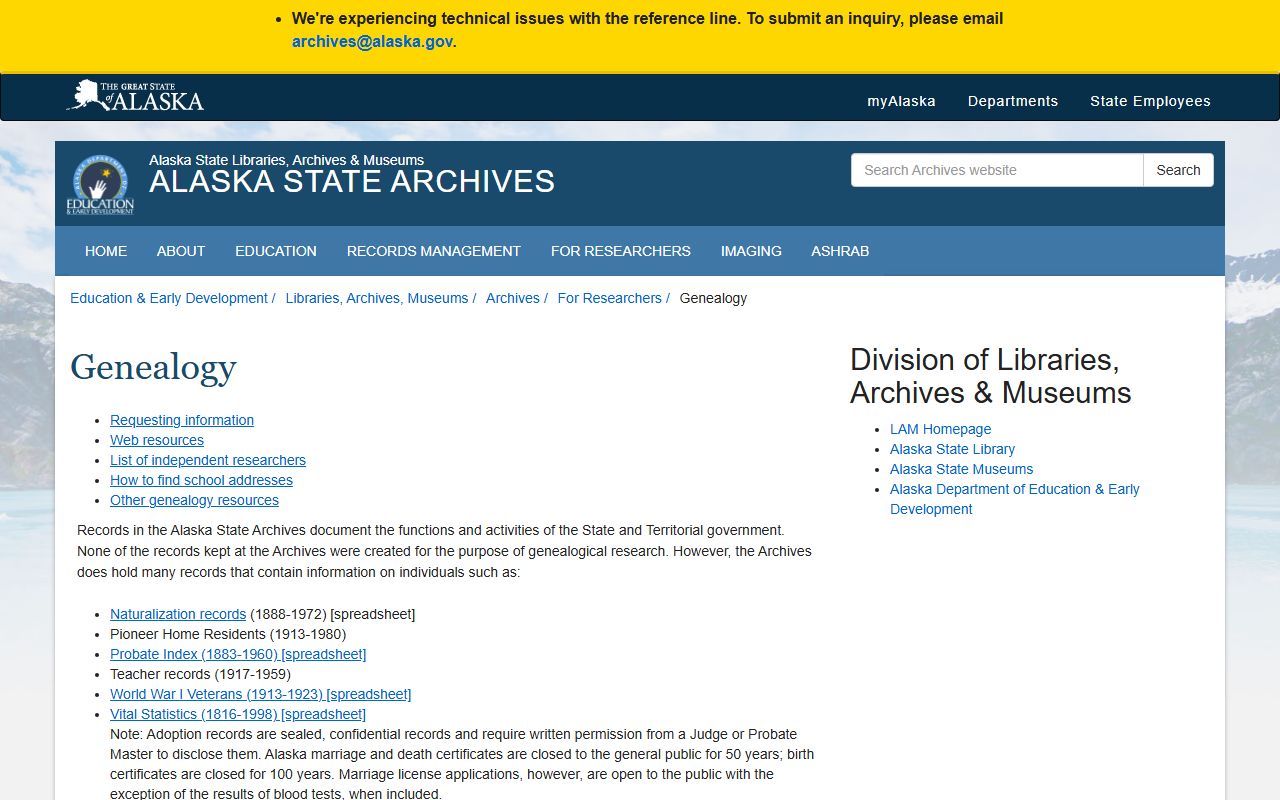
The archives hold over 1.1 million documents from across Alaska's history. For Skagway research, their collection includes territorial court records from the early period of U.S. administration, which often contain death-related filings such as probate records and coroner's reports.
Skagway Museum and Historical Collections
The Skagway Museum maintains historical collections tied to the Klondike Gold Rush and Skagway's history. The museum holds photographs, artifacts, and documents with genealogical value for researchers studying deaths and lives in Skagway from the late 1800s onward. The museum is operated by the municipality and is located within the Skagway government structure.
Contact the Skagway Museum through the municipality's website at skagway.org. Museum staff can advise you on what historical materials are available for research and how to access them. Some collections may require an appointment or a written request. The museum's photographs alone are a significant resource, as many show identifiable individuals who lived and died in Skagway during the Gold Rush period.
The Klondike Gold Rush National Historical Park, operated by the National Park Service in Skagway, also maintains historical records and interpretive materials related to the Gold Rush era. While the park focuses on history rather than genealogy, park staff can direct researchers to relevant collections and may have access to historical materials not available elsewhere.
FamilySearch holds several other Alaska collections useful for Skagway research beyond the coroner's records. Federal census records from 1900, 1910, and 1920 include Skagway residents and can confirm who was living in the town at those points in time. Combining census records with the coroner's records and newspaper archives gives researchers a fairly complete picture of Skagway's population during its most active period.
Property Records and Legal Framework
Property records for Skagway are maintained through the Alaska Land Records and Information System. ALRIS is managed by the Alaska Department of Natural Resources. The recorder function for Skagway is handled at the municipal level, as the Municipal Clerk at 700 Spring Street records deeds, mortgages, and other property instruments. These records can help establish that a person was a Skagway resident and may assist with estate research following a death.
ALRIS is accessible online at dnr.alaska.gov. Property records are useful research supplements when vital records are incomplete or when you need to confirm details about a deceased person's holdings in Skagway.
The National Archives holds federal records that can supplement local research. Federal court records from Alaska, accessible through the NARA guide at archives.gov, include probate filings and other death-related documents from the early territorial period. Skagway's status as one of Alaska's busiest early communities means more federal court activity was recorded there than in most small Alaska towns.
Alaska's vital records system is governed by the Vital Statistics Act, found in Title 18 of the Alaska Statutes. The full text is available at law.justia.com. The act sets out registration requirements, timelines, and access rules. Deaths must be registered within 10 days. The funeral director or person handling disposition files the certificate with HAVRS. Reading the act's key sections helps you understand what to expect when you submit a records request.
The Alaska State Library's genealogy guide at library.alaska.gov lists major genealogical collections across Alaska. The library's reference staff can help by phone or email with questions about Skagway-specific research. The CDC's guide to Alaska vital records at cdc.gov is a concise overview of the state's vital records history and access rules. Both resources are worth checking early in any Skagway death records research project.
What to Expect in a Death Certificate
A certified Alaska death certificate includes the full legal name of the deceased, date and place of death, cause of death, and information about the attending physician or coroner. It also includes the names of the deceased's parents and surviving family members in many cases. For Skagway, recent death certificates follow the same format as those from any other Alaska municipality.
Historical records, particularly those from the Gold Rush era, may differ in format and detail. Coroner's records from the 1898 to 1935 period on FamilySearch vary in how much information they contain. Some are detailed case reports. Others are brief notations. The quality depends on who filed the record and what information was available at the time.
Cause of death listed on Gold Rush era records reflects the medical knowledge and social context of the time. Causes such as "exposure," "exhaustion," and "mountain fever" appear frequently. For deaths that occurred during the Chilkoot Trail crossing, the records may list only location information without a specific cause. If you are researching a Gold Rush era death, be prepared to cross-reference multiple sources to build a complete picture.
For current requests, HAVRS staff are available by phone to answer questions about the process. The main number is (907) 465-3391. Staff can tell you what documentation you need for your specific request and can estimate current processing times. Processing times vary by season and request volume, so calling ahead is worthwhile if your request is time-sensitive.
Nearby Boroughs and Census Areas
Cities in Skagway Municipality
Skagway is a unified municipality. There is only one community within its boundaries, the town of Skagway itself. The permanent population is approximately 1,000 residents, and there is no dedicated death index page for Skagway. Death records for all Skagway residents are maintained by HAVRS in Juneau. The municipality's administrative office at 700 Spring Street can assist with local questions and referrals.