
Alaska Death Index
The Alaska death index is maintained by the Health Analytics and Vital Records Section (HAVRS), the state office that holds all vital records in Alaska. Death entries in the index go back to the 1890s, with statewide registration required since 1913. Searching the Alaska death index can help you get a certified copy of a death certificate, confirm a death date for legal purposes, or trace family history through Alaska's territorial period. You can request records in person at HAVRS offices in Juneau and Anchorage, order online through VitalChek, or mail a written request to the state office in Juneau.
Alaska Death Index Overview
Where to Find the Alaska Death Index
The Alaska Health Analytics and Vital Records Section (HAVRS) serves as the official state agency for all vital records, including the death index. HAVRS is part of the Division of Public Health within the Alaska Department of Health. The agency maintains two walk-in offices where you can request certified copies of death certificates in person. The Juneau office is at 5441 Commercial Boulevard, Juneau, AK 99801, and can be reached at (907) 465-3391. The Anchorage office is at 3901 Old Seward Highway, Suite 101, Anchorage, AK 99503, telephone (907) 269-0991. Both offices are open Monday through Friday, 8:30 AM to 4:30 PM, excluding state holidays. Walk-in requests are often handled the same day.
The HAVRS main page links to ordering forms, fee schedules, and contact information for all vital records services in Alaska.
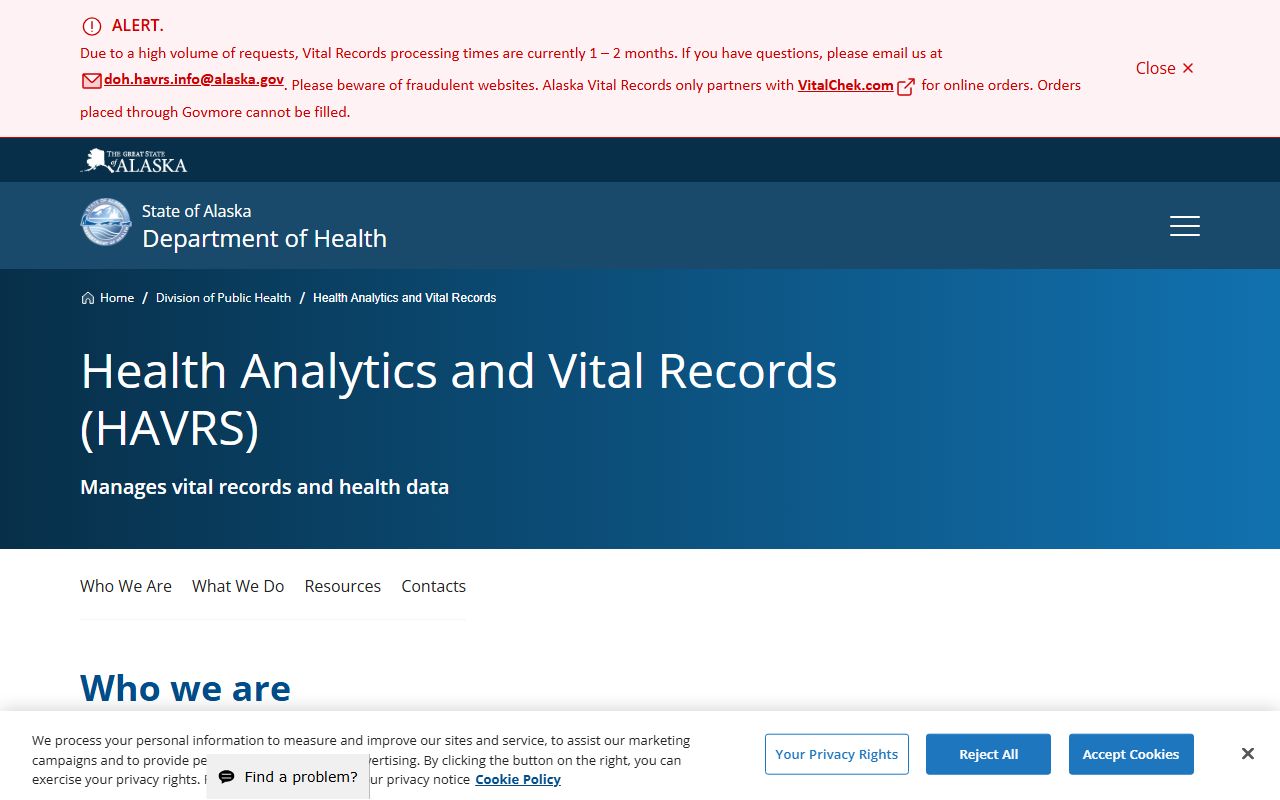
HAVRS oversees the Alaska death index along with birth, marriage, and divorce records for the entire state, making it the single point of contact for all vital records in Alaska.
VitalChek is the only vendor authorized by Alaska Vital Records for online orders. The state warns that other online services are not approved and may charge high fees without guaranteeing delivery. If you see a third-party website offering to pull Alaska death index records for a steep fee, it is not authorized by the state.
If you can't visit in person, a mail or fax request is your best option. Mail your written request along with a copy of your government-issued photo ID to P.O. Box 110675, Juneau, AK 99811-0675. The fax line is (907) 465-3618. Make checks or money orders payable to "Alaska Vital Records Office." Mail and fax requests take roughly 2 to 3 months to process, which is much slower than the 2 to 3 week window for online VitalChek orders. Keep that difference in mind if you need a record for an upcoming legal matter. Your ID copy must be enlarged and lightened so it is fully legible when the office receives it. A signature under the ID copy is required. The CDC's official directory for Alaska vital records confirms these contact details and fee amounts, and it's a good source to check if you want federal verification of where and how to send your request.
Note: Requests submitted before a death has been formally registered will be delayed, since registration itself can take up to three months after the death occurs.
What the Alaska Death Index Contains
A standard Alaska death certificate includes the full name of the deceased, their date and place of death, date and place of birth, and burial or cremation details. The record also lists the decedent's occupation, residence at the time of death, race, gender, and marital status. Cause of death is recorded along with the attending physician's name. The names of the deceased person's parents, including the mother's maiden name, are typically on the certificate, as is the name of the informant who provided details to the registrar.
Older records from Alaska's territorial period often contain more detail than modern certificates. The Alaska State Archives notes that death certificates going back to the 1816 to 1959 era may also include the date and place of burial, a physical description of the deceased, the undertaker's name, and names of surviving relatives. These early records are part of the State Archives Vital Statistics collection and have been digitized through a partnership with FamilySearch. That project produced a searchable online index linked to more than 1.1 million digitized documents, including birth, marriage, death, and probate records from Alaska going back to the mid-1800s. Researchers should look at the original certificate image rather than relying only on the index entry, since indexes can have transcription errors or miss details found in the full record.
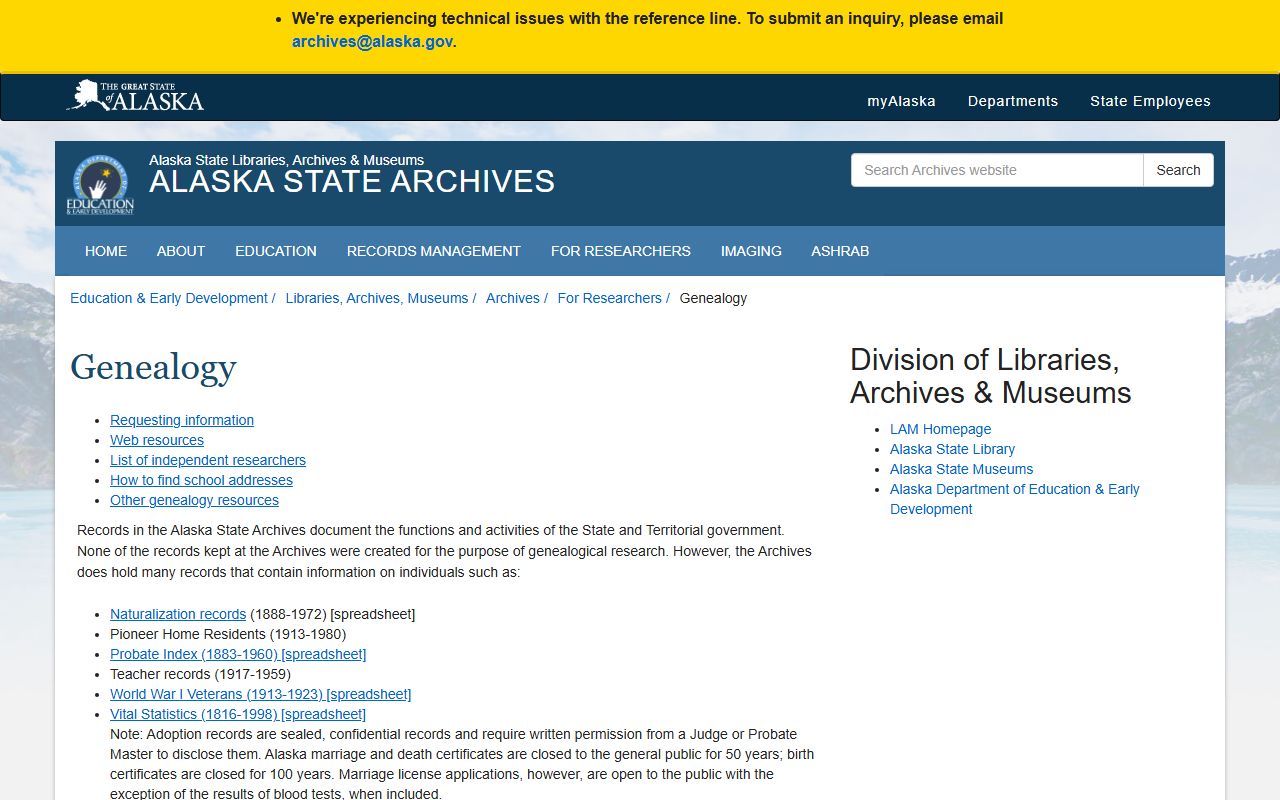
The Alaska State Archives genealogy page points researchers to the full Vital Statistics collection, probate records, coroner's inquests, and the digitized FamilySearch holdings spanning from the 1800s through 1998.
Death records from before 1913 exist but are spotty. Many deaths in Alaska's territorial period were never registered, especially in remote communities. If your search turns up nothing before 1913, it may be because the event was never recorded.
How to Request Alaska Death Records
To request a certified copy from the Alaska death index, you need the full name of the deceased, the date of death, and the place of death. Your request must include a copy of a government-issued photo ID. Accepted forms are a driver's license, state-issued ID, passport, military ID, or a Tribal/BIA card with photo. The ID copy must be enlarged and lightened so it is readable. You also need to sign under the photocopied ID. Without these items, the office will not process your request.
For death records less than 50 years old, only specific parties can make a request. Eligible requestors include the spouse listed on the certificate, parents of the deceased, children of the deceased, and siblings of the deceased. Each must provide supporting documentation to prove the relationship, such as a marriage certificate or birth certificate if the relevant event occurred outside Alaska. Attorneys and government agencies may also request records with a letter on official letterhead explaining who they represent and why the record is needed. The Office of Public Advocacy may request records with certified Delegated Power of Conservatorship or Guardianship papers.
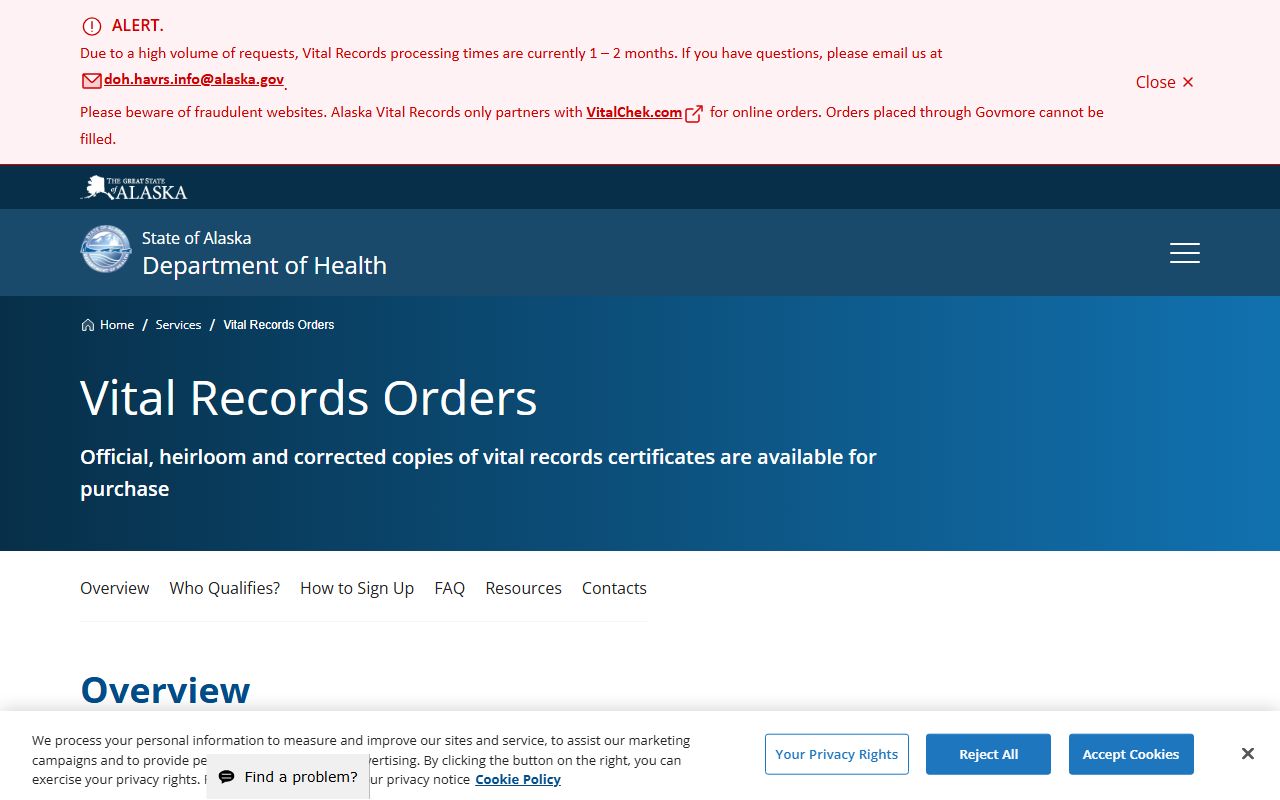
The HAVRS vital records orders page has downloadable request forms and step-by-step instructions for each submission method, covering in-person, online, mail, and fax requests.
Processing times vary quite a bit by method. In-person requests at the Juneau or Anchorage office are generally handled the same day. Online orders through VitalChek take 2 to 3 weeks. Mail or fax requests take 2 to 3 months. If you need to correct or amend a certificate, those changes go through the Special Services Unit and take about 3 months regardless of how you submit. Corrections require original documents or certified copies and cannot be submitted electronically. The Special Services Unit can be reached at (907) 465-1200 or at BVSSpecialServices@alaska.gov.
Note: Expedited processing is not available for corrections or amendments to Alaska death certificates, even if the original request was submitted in person.
Alaska Death Certificate Fees
The first certified copy of an Alaska death certificate costs $30. Additional copies of the same record ordered at the same time are $25 each. These state fees apply whether you order in person, by mail, by fax, or through VitalChek. However, VitalChek adds its own service fee on top of the state cost to cover online processing and identity verification. The total through VitalChek will be higher than ordering directly by mail.
VitalChek's Alaska death records page is the only state-authorized online ordering portal, and it covers standard certified copies as well as apostille service for international use, with records available from 1913 to the present.
Veterans may receive free certified death certificates. Under changes to AS 18.50.320 enacted through House Bill 99, the Bureau of Vital Statistics must issue up to four certified copies of a qualifying veteran's death certificate at no charge to eligible recipients. This provision exists specifically to help families satisfy eligibility requirements for veterans' benefits.
Uncertified white copies of vital records are available for $10 per copy. These are useful for genealogical research when a certified copy is not required. For researchers who need access to aggregate death statistics rather than individual certificates, the HAVRS Data Request Application program allows approved organizations and researchers to obtain vital statistics data. These data requests are billed at $75 per staff hour, with separate fees for data matching and recurring dataset distribution. Researchers submit a Data Use Agreement to HealthAnalytics@alaska.gov to start the application process. This pathway is for research and public health use, not for individuals seeking a specific death record.
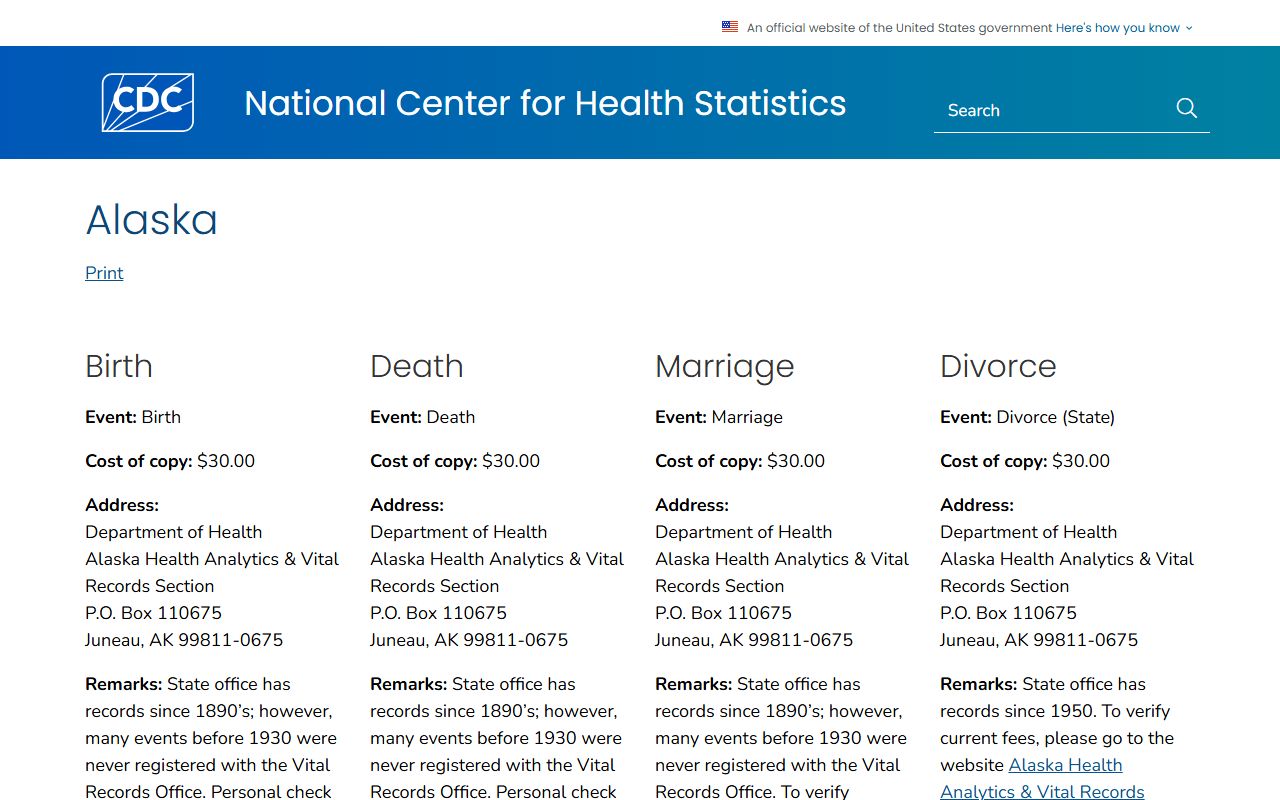
The CDC's Where to Write for Vital Records page for Alaska confirms the fee structure and mailing address, and it's maintained by the federal government as an authoritative reference for anyone unsure about where to send their request.
Who Can Access Alaska Death Records
Alaska controls access to death records through the Vital Statistics Act, codified at Alaska Statutes Title 18, Chapter 50 (AS 18.50). Under AS 18.50.310, it is unlawful to inspect, copy, or disclose information from vital statistics records except as authorized by the statute or its accompanying regulations. This legal framework keeps recent death records restricted to a defined set of eligible parties.
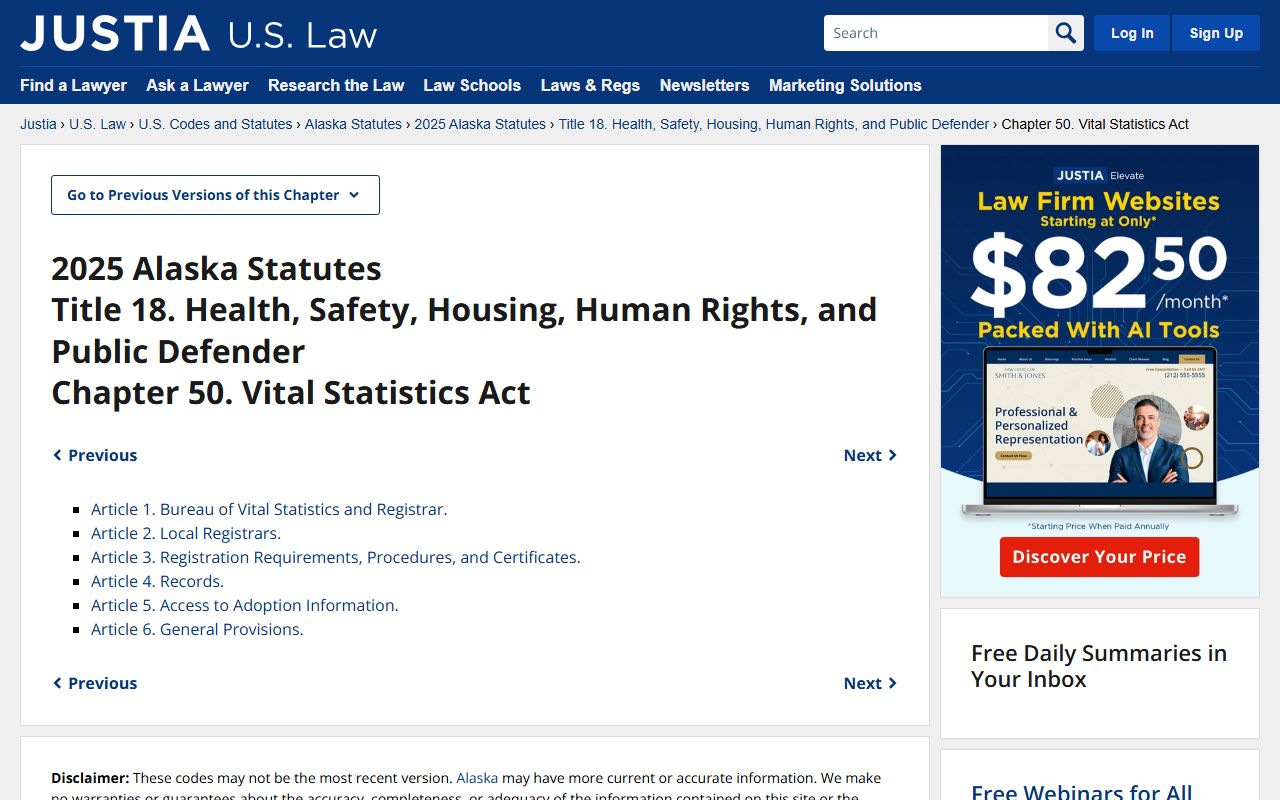
The Alaska Vital Statistics Act at AS 18.50 establishes the disclosure rules, public access timelines, certified copy procedures, and special provisions for researchers and veterans.
AS 18.50.310(a) and (f) set the timeline that determines when death records become public. Once 50 years have passed from the date of death, the record is no longer restricted and anyone can request it. Before that threshold, access is limited to the eligible parties described above. Birth records have a longer closure period of 100 years. The Reporters Committee for Freedom of the Press confirms this interpretation and notes that Alaska's general public records law specifically defers to AS 18.50 for vital statistics, meaning Alaska's open records statutes do not override the vital records access restrictions.
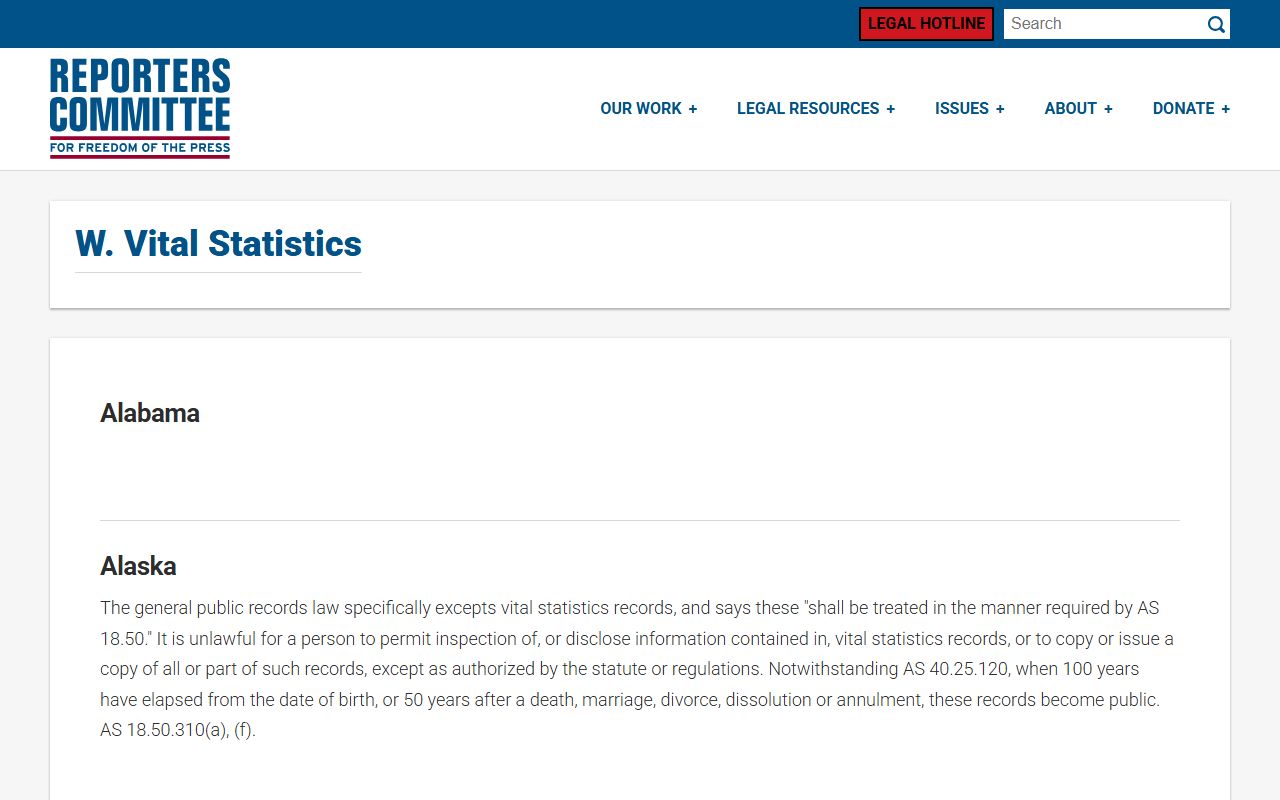
Alaska's vital records access framework has been examined by the Reporters Committee, which confirms that the 50-year public access rule applies to death, marriage, divorce, dissolution, and annulment records across all boroughs and census areas in the state.
AS 18.50.310(b) does allow limited access for research purposes. Qualified researchers can apply to HAVRS for access to vital statistics data under a Data Use Agreement, subject to privacy safeguards and review by the HAVRS Research Unit.
Historical Death Records at the Alaska State Archives
The Alaska State Archives in Juneau holds the state's historical vital records and serves as the primary repository for government-created records going back to the territorial period. The Archives' Vital Statistics collection runs from 1816 to 1998 and is available as a searchable spreadsheet. For researchers looking for death records from before the digital era, this is the first place to check. The Archives also holds the Probate Index from 1883 to 1960, naturalization records from 1888 to 1972, and Coroner's Inquests from 1898 to 1969. Those coroner's inquest records are especially valuable for deaths under unusual circumstances during Alaska's gold rush and territorial periods.
One of the largest developments in Alaska death record research was the Archives' partnership with FamilySearch to digitize 1.1 million historical documents. This project created a searchable online index linked to digitized images of original birth, marriage, death, and probate records going back to the mid-1800s. The FamilySearch collection for Alaska includes death records from 1816 to 1959. Entries can include the name of the deceased, date and place of death, burial information, occupation, cause of death, names of parents, and informant details. FamilySearch also holds the Juneau Coroner's Records from 1899 to 1969, and various territorial court records that document deaths in early Alaska communities. Most of these resources are free to search online, which makes Alaska's historical death index far more accessible than it was even a decade ago. Researchers should always pull the original certificate image rather than relying on the index alone, since transcriptions may contain errors or omit details found in the full record.
The Archives holds Pioneer Home Residents records from 1913 to 1980. These records document individuals who lived in Alaska's state pioneer homes, which housed many longtime Alaska residents in their final years. They can be a useful supplement to official death records when no certificate was filed.
Alaska Newspaper Records and Obituaries
Newspaper obituaries and death notices are a critical secondary source for Alaska death research, especially when official records are incomplete or unavailable. The Alaska State Library's genealogy page points to several specialized newspaper death indexes. The Anchorage Times Obituaries Index covers 1915 to 1990 and is held at the Anchorage Genealogical Society library at Loussac Library. The Anchorage Daily News Obituary Index extends from 1991 to 2007. The Index of Births, Deaths, Marriages and Divorces in Fairbanks Newspapers runs from 1903 to 1930. These print indexes help researchers narrow down a date and issue before pulling the actual microfilm.
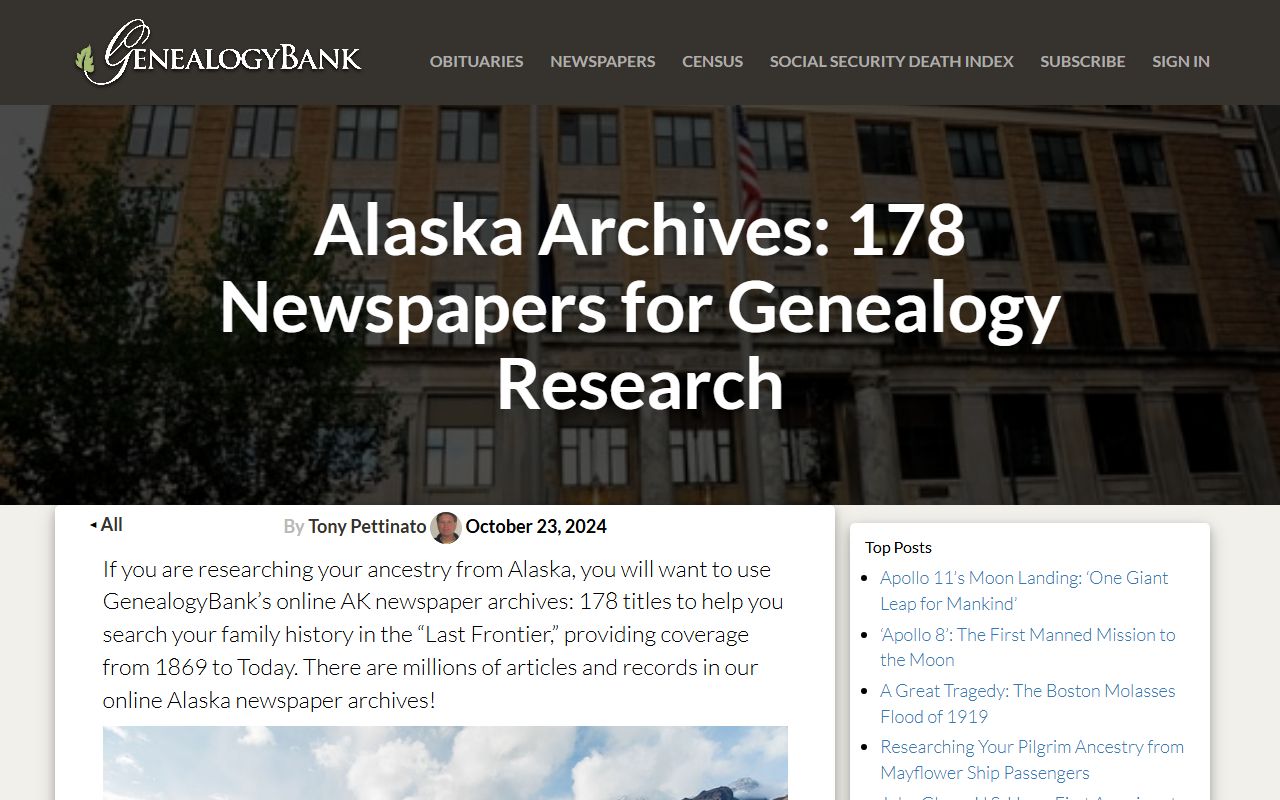
The GenealogyBank Alaska newspaper archive holds 178 newspaper titles covering 1869 to the present, with obituary collections dating back to 1946, including thousands of issues of the Anchorage Daily News, Anchorage Daily Times, and Fairbanks Daily News-Miner.
The Alaska State Library maintains the Alaska Newspapers on Microfilm collection from 1866 to 1998, covering papers from communities across the state. Notable publications for death research include Vital Records from the Alaska Daily Empire in Juneau, covering 1916 to 1936, and Births, Marriages, Divorces and Deaths Reported in the Fairbanks Daily News-Miner for 1940 to 1949. The Patricia Roppel Index of Alaska Obituaries from various sources covers 1899 to 1995 and is a broad-ranging compilation that spans the territorial period through much of the 20th century. Newspaper obituaries frequently contain information not found on official death certificates, such as names of extended family members, funeral arrangements, biographical details about the deceased's life in Alaska, and accounts of the circumstances of death. When a death was never formally registered, the newspaper may be the only surviving record.
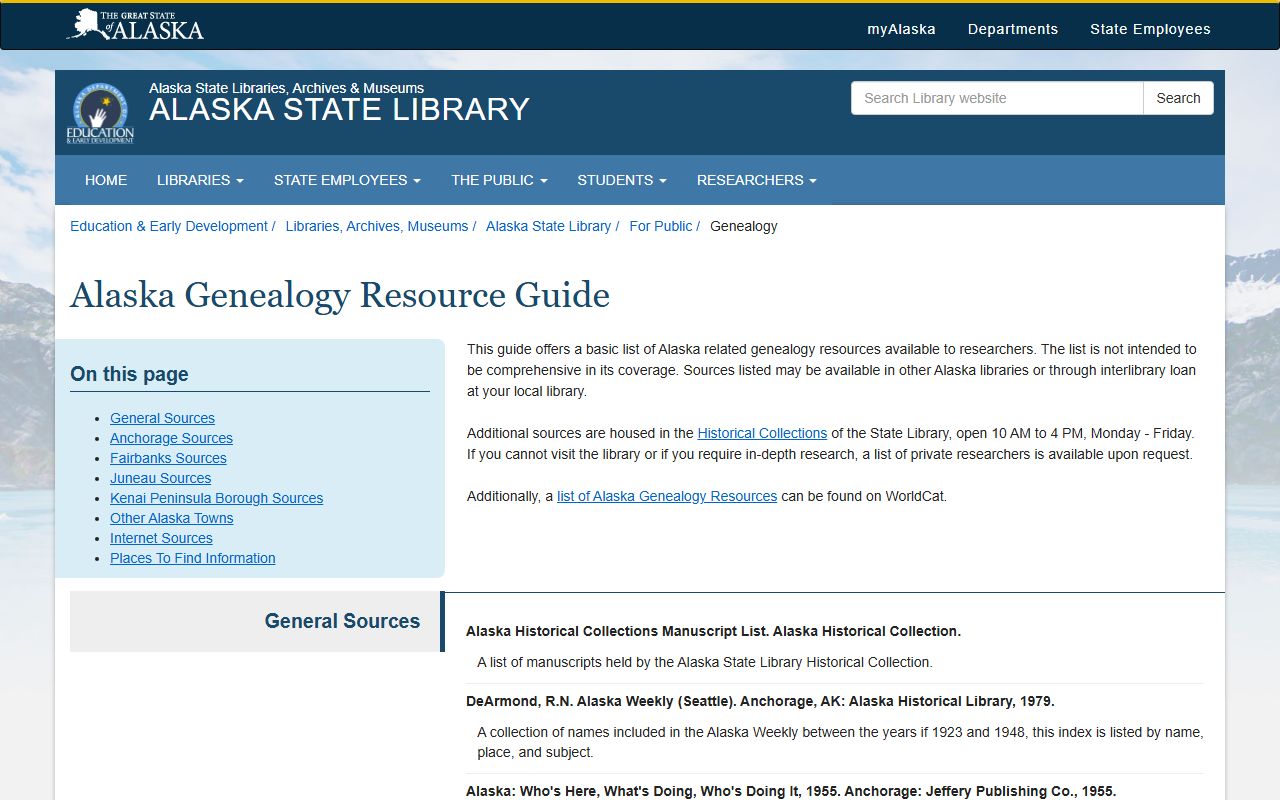
The Alaska State Library genealogy resources page provides guides to obituary indexes, newspaper microfilm collections, historical document archives, and links to FamilySearch and other key death research databases for Alaska.
Free Death Certificates for Alaska Veterans
Alaska enacted special provisions for veterans' death certificates through House Bill 99 (2023), which amended AS 18.50.320. Under this law, the Bureau of Vital Statistics must issue up to four certified copies of a qualifying veteran's death certificate at no charge to eligible recipients. The purpose is to help surviving family members satisfy eligibility requirements for veterans' benefits, where a certified death certificate is typically a required document.
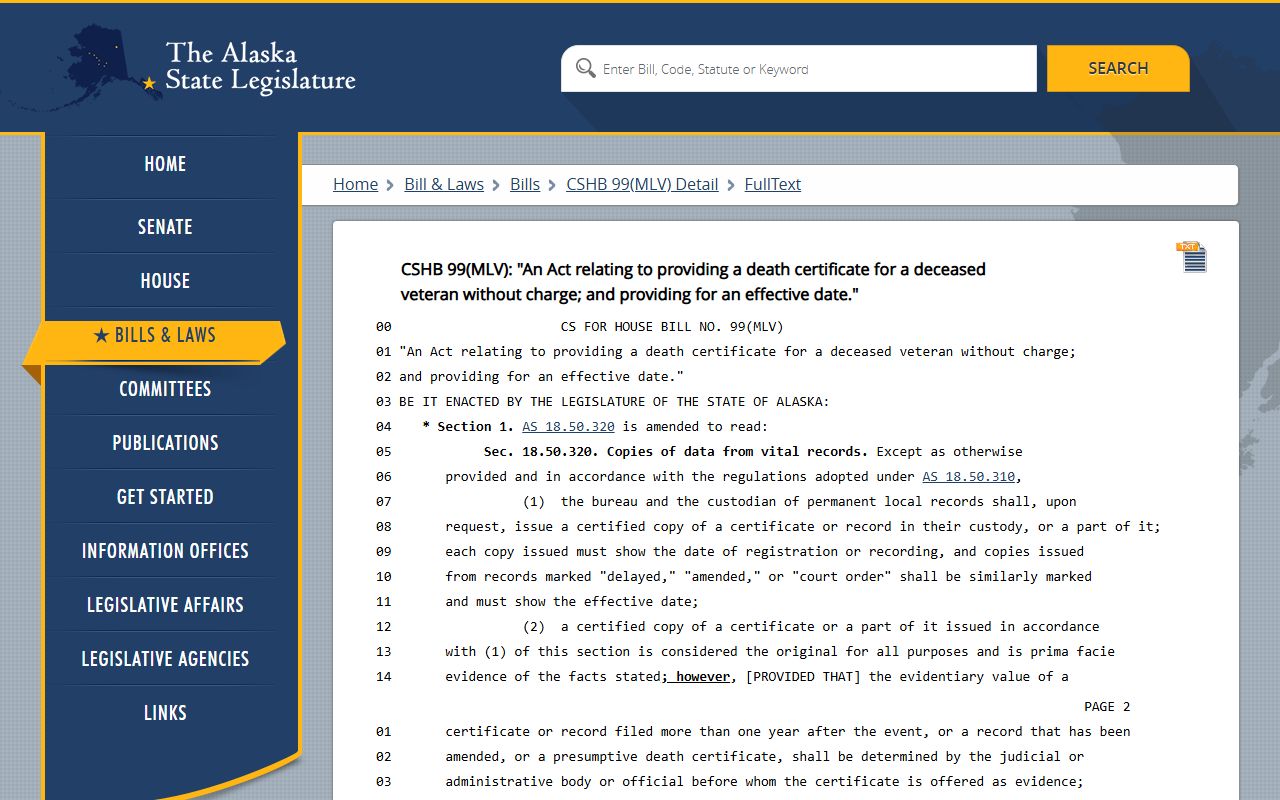
The Alaska Legislature's HB 99 text sets out the full definition of qualifying veterans and the list of eligible recipients for free death certificates under the amended AS 18.50.320.
The law defines a "veteran" as someone who was on active duty at the time of death, or who received an honorable or general discharge from a branch of the U.S. armed services. The definition also covers the Alaska Scouts, Alaska Territorial Guard, Alaska Army National Guard, Alaska Air National Guard, Alaska Naval Militia, U.S. Coast Guard, and reserve units of the armed services or Coast Guard stationed in Alaska. The veteran must have been an Alaska resident at the time of death. Eligible recipients for the free copies include the surviving spouse, next of kin, heirs, estate administrators, executors, personal representatives, conservators, fiduciaries, and trustees of the deceased veteran's estate. To claim this benefit, request the certificate through HAVRS and indicate that the deceased was an Alaska veteran at the time of death.
Federal Death Records at NARA
The National Archives and Records Administration maintains a facility in Anchorage that holds federal court records, military records, naturalization records, and other agency records for Alaska. For death research, the most relevant holdings are Alaska naturalization records from 1884 to 1991. These records sometimes document deaths that occurred before a naturalization petitioner completed the process, capturing death information outside the regular vital records system. The NARA court records research guide explains what Alaska records are held in Anchorage and how to submit requests. There is no central index to naturalization records, so researchers need to know the approximate date and location of the naturalization proceeding to locate a specific file.
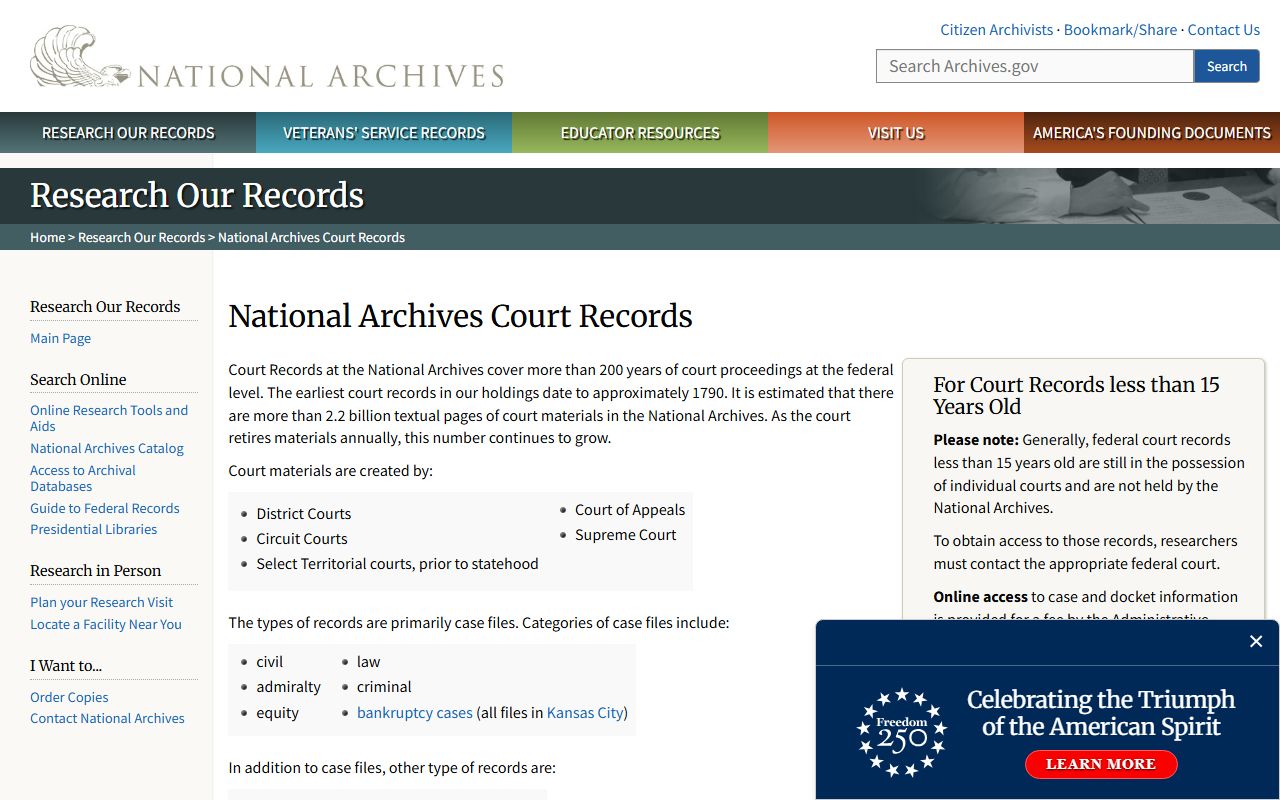
The National Archives court records guide covers naturalization files, military death records, and territorial court documents held in the Anchorage facility, all of which can supplement official Alaska death records for territorial-era research.
NARA also holds Alaska census records, land records, and military service records. Census records are valuable when a death certificate was never filed, since they can confirm when a person last appeared in a household and when they disappeared from subsequent records. Military service records may include death information for Alaska veterans who died in service or shortly after discharge.
Browse Alaska Death Index by Location
Alaska death records are centralized through the state HAVRS system, but local borough offices, libraries, and archives hold supplementary records. Select a borough or census area below to find location-specific death record resources, contact information, and historical collections for that area.
View All 30 Alaska Boroughs and Census Areas
Alaska Death Index by City
Major Alaska cities are served by HAVRS through the state system. Select a city below for local death record resources, borough connections, and historical collections specific to that community.