
Kenai Death Index Records
Kenai death index records are handled through the Alaska Health Analytics and Vital Records Section, which issues all certified death certificates for deaths that occur within the City of Kenai and the surrounding Kenai Peninsula Borough. The Cook Inlet coast city sits within one of Alaska's most research-rich boroughs for genealogy, with FamilySearch collections covering Kenai death records dating back to 1914 and coroner records going back even further, making Kenai an interesting case for anyone researching family history on the central Kenai Peninsula.
Kenai Death Index
Kenai Peninsula Borough and Local Government
Kenai operates as a home rule city within the Kenai Peninsula Borough. The City of Kenai provides municipal services for the city proper. The city clerk maintains local administrative records but does not issue vital records. For death certificate requests, all orders go through HAVRS at the state level, not through the city. The city website may be accessed at www.cityofkenai.org, noting that it may be temporarily unavailable at times.
The Kenai Peninsula Borough at www.kpb.us is headquartered at 144 North Binkley Street, Soldotna AK 99669, phone (907) 262-4441. The borough handles property assessment, planning, and other area-wide functions. Its online property search can help locate information related to estates or property transfers connected to a decedent, but the borough does not hold death records.
The Kenai Peninsula Borough portal is shown below and gives an overview of borough services across the peninsula, including Kenai and neighboring communities.
The borough website provides access to property records, meeting information, and department contacts that can be useful when researching estate-related matters alongside vital records searches.
Getting Certified Death Certificates
HAVRS at 5441 Commercial Boulevard, Juneau AK 99801, phone (907) 465-3391, is where all certified Kenai death certificates come from. For Kenai Peninsula residents, the Anchorage HAVRS office at 3901 Old Seward Highway Suite 101, phone (907) 269-0991, is often more accessible. The Anchorage office accepts walk-in requests Monday through Friday, 8:30 a.m. to 4:30 p.m., and offers same-day service for in-person visits.
Certified copy fees are $30 for the first copy and $25 for each additional copy of the same record ordered at the same time. Records under 50 years old are restricted to eligible parties. To qualify, you must be a spouse, parent, adult child, sibling, legal guardian, or someone who can demonstrate a direct and tangible legal interest in the record. Records that are 50 or more years old are open to anyone without a showing of eligibility or relationship.
Online orders go through VitalChek at vitalchek.com. Mail orders use the form at health.alaska.gov/en/services/vital-records-orders/. Include a copy of your photo ID and a signed statement of your relationship to the deceased when submitting by mail. Processing for mail and online orders typically takes two to four weeks.
FamilySearch and Historical Collections
FamilySearch has a notable collection of Kenai Peninsula records that goes well beyond what HAVRS holds. The FamilySearch wiki page for Matanuska-Susitna and Kenai Peninsula Borough genealogy at familysearch.org lists specific datasets including Kenai Death Records from 1914 to 1986, Kenai Peninsula Coroner's Records from 1900 to 1959, and Cape Nome Precinct Death Records from 1899 to 1937. These older records fill in the gap between modern HAVRS records and the pre-territorial period.
The Alaska State Archives page shown below covers genealogical resources including territorial records relevant to the Kenai area.
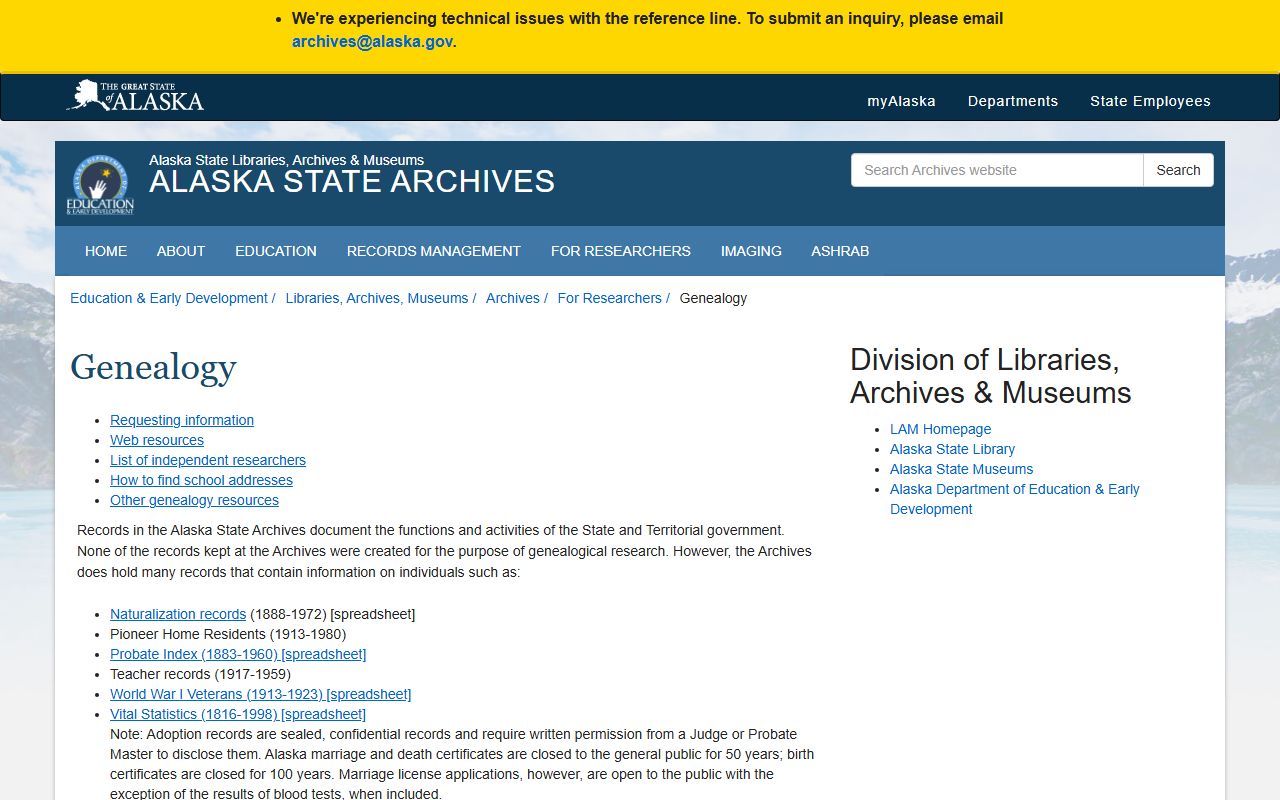
Through the state archives you can access territorial-era administrative records and early court filings that complement the FamilySearch collections for the Kenai Peninsula area.
The coroner's records held through FamilySearch are especially useful for deaths between 1900 and 1959, a period when formal death registration was not consistent across Alaska. Coroner records often contain more detail about the circumstances of death than a standard death certificate, making them valuable for both genealogy and historical research.
The Homer News at www.homernews.com covers the southern Kenai Peninsula including the Kenai area and maintains obituary archives. For deaths in the greater Kenai region, the newspaper's archive can help confirm the fact of death and provide context about the deceased's community connections. The Seward City Museum at www.sewardmuseum.org holds historical records for the Kenai Peninsula region that may be relevant to research covering the broader peninsula.
Understanding What the Index Shows
The Alaska death index covers records from statehood in 1959 forward. Each entry includes the decedent's name, date of death, place of death, and the certificate number needed to order a certified copy. Cause of death and next-of-kin details do not appear in the index; those are on the full certificate. For Kenai records, the place of death field typically reads Kenai, though some records for deaths occurring in the borough outside city limits may show the borough name instead.
When searching the index by name, consider that some Kenai area records may list nearby communities like Soldotna or the borough as the place of death depending on where the hospital or facility was located. Searching on name and year range rather than location can help avoid missing records due to place-of-death variations.
Informational or non-certified copies of death records can be obtained for research purposes without proving eligibility. These copies are useful for genealogy but are not valid for any legal or official purpose. They do not carry the state seal. If you need proof of death for an estate, insurance claim, or government agency, you must request a certified copy and meet the eligibility requirements for restricted records if applicable.
The Alaska State Library's genealogy resources at library.alaska.gov/public/akgene.html offer guides on navigating the different layers of Alaska records, from HAVRS to the archives to local sources. These guides are particularly helpful when you are not sure where to start for Kenai Peninsula research.
Vital Records Law and Access Rules
The Alaska Vital Statistics Act is the governing law for all death record access in the state. It is codified in Title 18, Chapter 50 of Alaska Statutes and can be read at law.justia.com/codes/alaska/title-18/chapter-50/. The statute sets the 50-year threshold for public access, defines which family members qualify to request restricted records, and establishes the fee schedule. The same rules apply uniformly to Kenai records as to all other Alaska death certificates.
Veteran families should note that legislation related to veteran death certificates has been considered in the Alaska Legislature. The bill text for veteran certificate legislation can be found at akleg.gov/basis/Bill/Text/26. Check the current status of any relevant legislation to understand whether it affects your request.
The CDC's Alaska vital statistics page at cdc.gov/nchs/w2w/alaska.htm provides state-level mortality data and links to the HAVRS system. While not useful for individual lookups, it provides context on Alaska's overall vital records infrastructure and the data collected at the national level.