
Nome Census Area Death Records Index
The Nome Census Area death index draws on both current state vital records and a surprisingly deep set of historical sources going back to the gold rush era. Searching the death index for this western Alaska census area gives you access to records from the City of Nome and surrounding Inupiat and Yup'ik communities, with some of the most detailed early-twentieth-century death documentation found anywhere in rural Alaska.
Nome Census Area Death Index
About Nome Census Area
Nome Census Area covers western Alaska on the Seward Peninsula, bordering the Bering Sea. It is an unorganized census area with no borough government. Nome itself is the regional hub, best known internationally as the finish line of the Iditarod Trail Sled Dog Race and for the gold rush that brought tens of thousands of people to the area around 1900. Today Nome serves as the service and administrative center for a network of smaller surrounding villages.
Communities in the census area include White Mountain, Elim, Golovin, Shaktoolik, Unalakleet, Stebbins, Saint Michael, Brevig Mission, Teller, Wales, and Shishmaref, among others. Most are small Alaska Native villages, predominantly Inupiat along the coast and some Yup'ik communities to the south. Access to virtually all of them requires a small aircraft.
Because there is no borough government, the census area has no local government office that handles vital records. The City of Nome provides municipal services to the city itself, but the City of Nome does not issue death certificates. All certified death records for Nome Census Area come from the state level through HAVRS.
The gold rush era brought large numbers of non-Native residents to Nome, which means the early-twentieth-century death records for this area are more extensive than for most remote Alaska regions. Coroner records, precinct court records, and early vital registrations all survived and have been partially indexed and digitized.
AKGenWeb Nome Resources
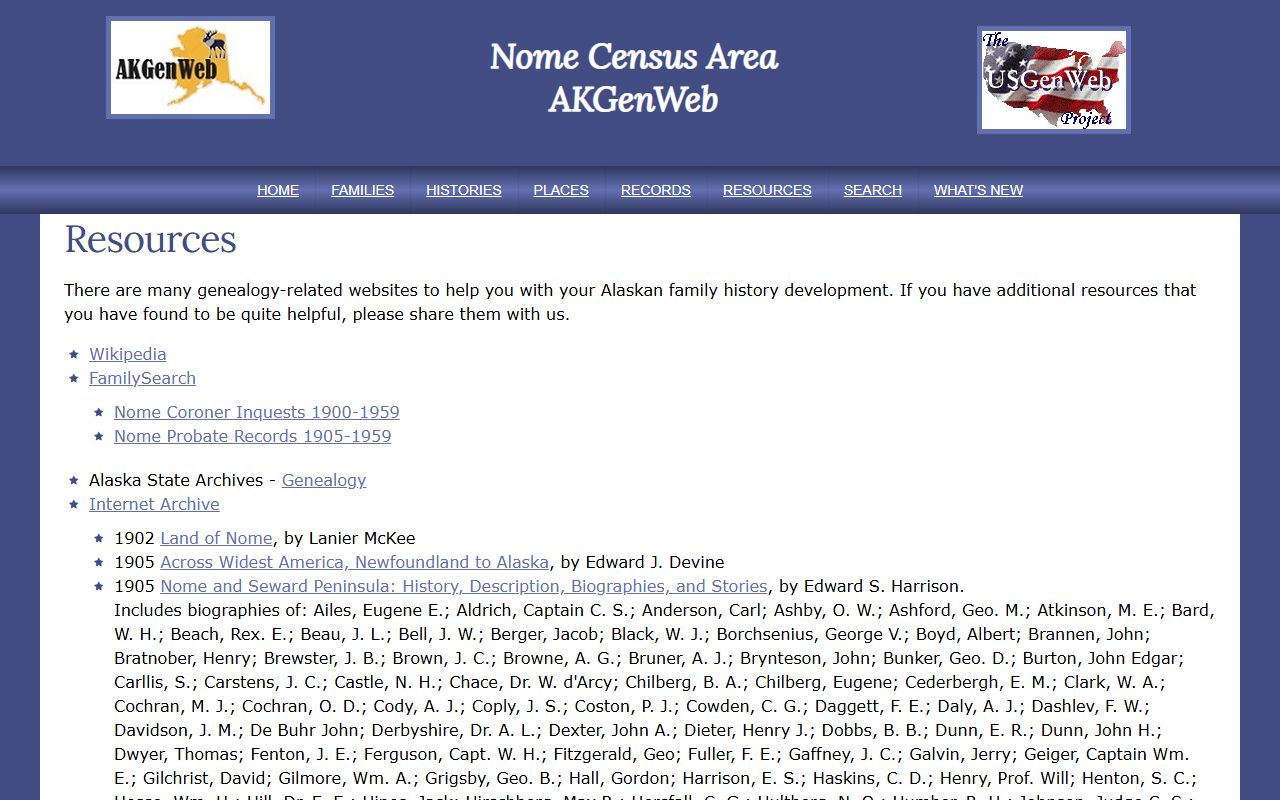
For historical death research, the AKGenWeb Nome resources page is one of the most specific and useful tools available. Their site at akgenweb.whalen-family.org indexes several key collections: Cape Nome Precinct Birth Records from 1894 to 1921, Cape Nome Precinct Death Records from 1899 to 1937, and Cape Nome Precinct Coroner's Records from 1900 to 1959.
The AKGenWeb Nome resources page provides free access to transcribed indexes of early Cape Nome death records and coroner inquests, covering the gold rush period and the decades that followed when Nome was one of Alaska's most populated places.
These pre-statehood records capture a period when Nome had a population of several thousand, including miners from all over the world. If you are researching a death from the early 1900s in the Nome area, the precinct death records and coroner files are the right place to start before looking at state-level records.
The 1918 influenza pandemic hit Nome and the surrounding villages especially hard. Deaths from that event are reflected in both the precinct death records and, for some communities, in church and mission records. Researchers looking for ancestors who died in that period should note that the volume of deaths in 1918 to 1919 means records may be less complete than in other years.
Alaska State Archives Nome Collections
The Alaska State Archives at archives.alaska.gov holds several Nome-specific record groups that go beyond the general statewide vital records collection. The archives include Nome Coroner Inquests from 1900 to 1959 and Nome Probate Records from 1905 to 1959. The archives staff have created a spreadsheet index for these collections, which makes searching faster than reading through unindexed records.
To access these specific collections, contact the Alaska State Archives directly. Staff can tell you whether a specific name appears in the inquest or probate indexes and what steps to take to request copies. The archives are located in Juneau, but many requests can be handled by mail or email.
The broader state genealogical collection at the archives spans 1816 to 1998 and includes over 1.1 million digitized records. For Nome Census Area, the archives are an essential resource for both the early gold rush era and the mid-twentieth century before HAVRS records became the primary system.
City of Nome and Municipal Records
The City of Nome provides municipal services to the city proper. Their website is at nomealaska.org. The City Clerk maintains local administrative records for Nome city government. These are not vital records, but the clerk's office can answer questions about Nome-specific matters and point researchers toward appropriate resources.
The City of Nome website shows current municipal services and contact information for city departments, which can be useful when trying to navigate research in this remote western Alaska community.
Nome has had a hospital and medical services presence since the early 1900s, which helped ensure that deaths in the city were more consistently recorded than in the smaller surrounding villages. The Anvil City Science Academy and the Carrie M. McLain Memorial Museum in Nome also hold local historical materials that can supplement formal records research.
HAVRS and Current Death Records
For deaths from the mid-twentieth century to the present, the Health Analytics and Vital Records Section is the right source. HAVRS maintains the Alaska death index and issues certified copies. Their Juneau office is at 5441 Commercial Boulevard, Juneau AK 99801, at (907) 465-3391. The Anchorage office is at 3901 Old Seward Hwy Suite 101, Anchorage AK 99503, at (907) 269-0991.
Death records less than 50 years old are restricted to immediate family members and authorized requesters. Records 50 years and older are public. The fee is $30 for the first certified copy and $25 for each additional copy ordered at the same time.
Order through the HAVRS website at health.alaska.gov, through VitalChek at vitalchek.com, or by mail to P.O. Box 110675, Juneau AK 99811-0675. Be sure to include as much identifying information as possible, since Nome Census Area includes many communities with similar names or with individuals sharing common family names.
FamilySearch and Online Collections
FamilySearch at familysearch.org holds an Alaska vital records collection covering 1816 to 2005. It is free to search. For Nome Census Area research, FamilySearch is worth checking both for the Nome city records and for the surrounding village records. Nome's prominence as a regional hub means more records were generated and preserved there than in more remote areas.
The Alaska Library at library.alaska.gov also provides genealogical resources and links to Alaska-specific databases. Their Alaska genealogy page lists collections and tools that can help with Nome area research, including newspaper archive links and church record guides.
Church records are especially worth pursuing for Nome area villages. Russian Orthodox churches were present in many western Alaska villages from the nineteenth century onward, and their baptism and burial records often predate formal government vital registration. The Orthodox records are held partly at the Alaska State Archives and partly at the national diocesan archives.
Nearby Boroughs and Census Areas
Cities in Nome Census Area
Nome is the largest community and the regional hub in this census area, but it does not have its own death index page. Use the state and local resources listed on this page to search the death index for Nome and the surrounding communities.